 Add to Chrome
 Add to Firefox
 Add to Edge
Do LLMs Build World Models From Text? A Multilingual Diagnostic of Spatial Reasoning
May 27, 2026
Whether large language models (LLMs) construct internal spatial world models from pure-text descriptions remains contested, and whether such capabilities transfer across languages has not been systematically studied. We introduce MentalMap, a multilingual diagnostic benchmark with a six-level capability hierarchy (L0-L5) spanning atomic spatial facts to generative world-graph construction, together with four diagnostic axes probing frame of reference, reading-direction bias, reasoning-effort allocation, and hallucination. MentalMap is built from 100 ProcTHOR household scenes, covers eight typologically diverse languages plus a structured-text control, and contains 39 task families across 1,950 evaluation cells. Evaluating thirteen LLMs across scales and model families, we identify a universal L3 reasoning cliff: no model retains even half of its L0 performance on viewpoint reasoning once baseline atomic accuracy exceeds 40%. The cliff persists across languages, scales, and prompting strategies, while structured-output failures and reasoning patterns vary substantially across models. Human evaluation under the identical pure-text protocol reproduces the same failure pattern, suggesting that the bottleneck arises from text-only working memory constraints rather than being specific to current LLM architectures. Our findings reframe pure-text spatial reasoning as a multi-axis world-modeling problem and motivate multimodal and scratchpad-augmented reasoning as future directions.

SpaMEM: Benchmarking Dynamic Spatial Reasoning via Perception-Memory Integration in Embodied Environments
Apr 24, 2026Multimodal large language models (MLLMs) have advanced static visual--spatial reasoning, yet they often fail to preserve long-horizon spatial coherence in embodied settings where beliefs must be continuously revised from egocentric observations under environmental change. We introduce SpaMEM (Spatial Memory from Action Sequences), a large-scale diagnostic benchmark that isolates the mechanics of spatial belief evolution via action-conditioned scene transformations (spawn, place, remove) over long interaction horizons. SpaMEM is built on a physically grounded dataset with 10,601,392 high-fidelity images across four modalities (RGB, depth, instance, semantic segmentation), collected from 25,000+ interaction sequences in 1,000 procedurally generated houses. We formalize embodied spatial reasoning as a three-level hierarchy with 15 diagnostic tasks: Level 1 measures atomic spatial perception from single observations; Level 2 probes temporal reasoning with oracle textual state histories to factor out perceptual noise; and Level 3 requires end-to-end belief maintenance from raw visual streams under the same task dimensions. We further evaluate both short-term (step-wise) updates and long-term (episodic) reconstruction. Benchmarking representative open-source VLM families reveals a consistent stacked bottleneck: coordinate-consistent grounding remains a hard ceiling, and the sharp collapse from Level 2 to Level 3 exposes a pronounced symbolic scaffolding dependency, where models succeed with text-based bookkeeping but struggle to sustain robust visual memory. SpaMEM provides a granular diagnostic standard and motivates explicit mechanisms for state representation, belief revision, and long-horizon episodic integration.
Evaluating Robustness of Large Audio Language Models to Audio Injection: An Empirical Study
May 26, 2025Large Audio-Language Models (LALMs) are increasingly deployed in real-world applications, yet their robustness against malicious audio injection attacks remains underexplored. This study systematically evaluates five leading LALMs across four attack scenarios: Audio Interference Attack, Instruction Following Attack, Context Injection Attack, and Judgment Hijacking Attack. Using metrics like Defense Success Rate, Context Robustness Score, and Judgment Robustness Index, their vulnerabilities and resilience were quantitatively assessed. Experimental results reveal significant performance disparities among models; no single model consistently outperforms others across all attack types. The position of malicious content critically influences attack effectiveness, particularly when placed at the beginning of sequences. A negative correlation between instruction-following capability and robustness suggests models adhering strictly to instructions may be more susceptible, contrasting with greater resistance by safety-aligned models. Additionally, system prompts show mixed effectiveness, indicating the need for tailored strategies. This work introduces a benchmark framework and highlights the importance of integrating robustness into training pipelines. Findings emphasize developing multi-modal defenses and architectural designs that decouple capability from susceptibility for secure LALMs deployment.
Blind Spot Navigation: Evolutionary Discovery of Sensitive Semantic Concepts for LVLMs
May 21, 2025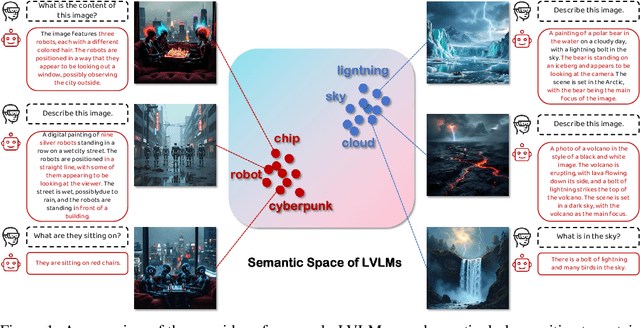
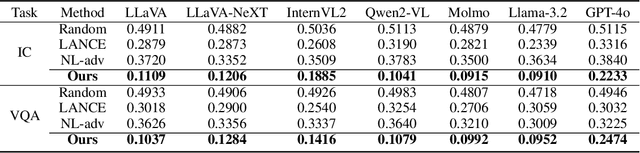
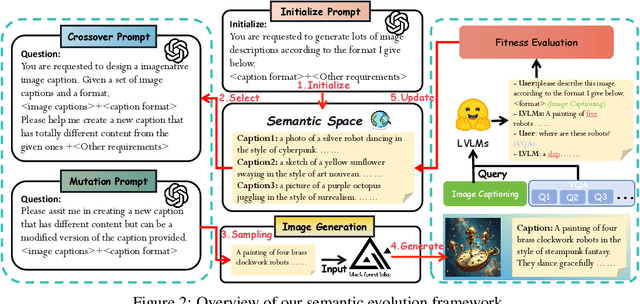
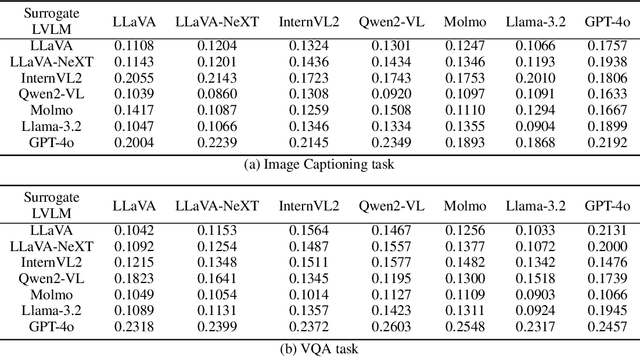
Adversarial attacks aim to generate malicious inputs that mislead deep models, but beyond causing model failure, they cannot provide certain interpretable information such as ``\textit{What content in inputs make models more likely to fail?}'' However, this information is crucial for researchers to specifically improve model robustness. Recent research suggests that models may be particularly sensitive to certain semantics in visual inputs (such as ``wet,'' ``foggy''), making them prone to errors. Inspired by this, in this paper we conducted the first exploration on large vision-language models (LVLMs) and found that LVLMs indeed are susceptible to hallucinations and various errors when facing specific semantic concepts in images. To efficiently search for these sensitive concepts, we integrated large language models (LLMs) and text-to-image (T2I) models to propose a novel semantic evolution framework. Randomly initialized semantic concepts undergo LLM-based crossover and mutation operations to form image descriptions, which are then converted by T2I models into visual inputs for LVLMs. The task-specific performance of LVLMs on each input is quantified as fitness scores for the involved semantics and serves as reward signals to further guide LLMs in exploring concepts that induce LVLMs. Extensive experiments on seven mainstream LVLMs and two multimodal tasks demonstrate the effectiveness of our method. Additionally, we provide interesting findings about the sensitive semantics of LVLMs, aiming to inspire further in-depth research.